You Won’t Believe What I Found Flying Over Nazca’s Ancient Lines
Flying over the Nazca Desert feels like slipping into another dimension. Below, mysterious geoglyphs stretch across the barren landscape—whales, spiders, and spirals etched into the earth centuries ago. I never expected such awe from a small plane ride. This isn’t just sightseeing; it’s stepping into a living puzzle left by an ancient culture. The silence up there, the scale, the mystery—it hits you deep. In this journey, I’ll take you through the real, raw cultural experience of Nazca beyond the textbooks.
The First Glimpse from Above – A Moment of Pure Awe
The adventure begins before sunrise at a modest airstrip just outside the town of Nazca, a quiet desert settlement in southern Peru. The air is crisp, the sky still dark with hints of purple and gray as travelers gather with a mix of excitement and nervous energy. Boarding a small six-seater Cessna aircraft, passengers are given headsets connected to the pilot’s voice—a crucial tool for understanding what lies ahead. The engine roars to life, and within minutes, the plane lifts off, climbing steadily into the pale morning light.
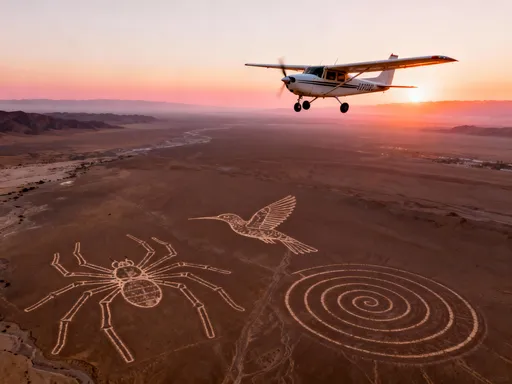
At first, the desert appears unremarkable—vast, dry, and seemingly empty. But as the plane banks gently to the left, the ground transforms. A massive spider, over 150 feet long, emerges from the ochre earth. Its delicate legs curve with precision, each line etched so clearly it seems drawn yesterday. Moments later, a hummingbird appears—a creature of grace frozen in time, wings outstretched as if caught mid-flight. These are not carvings but negative designs, created by removing the dark surface stones to reveal the lighter soil beneath. From ground level, they are nearly invisible. Only from the sky do they become legible.
The flight lasts approximately 30 to 40 minutes, a short duration that belies its emotional weight. Pilots follow a regulated route, circling key geoglyphs including the monkey, the astronaut, and the whale. Each turn offers a new perspective, and the sensation of floating above these ancient symbols creates a rare sense of wonder. Passengers often sit in silence, interrupted only by the pilot’s calm narration pointing out each figure. The experience is not just visual—it is spiritual. Seeing the lines from above helps travelers understand why aerial observation is essential: it restores the original intent of the creators, who may have designed them to be seen by deities or celestial beings.
For most visitors, the physical demands are minimal, though some may experience mild motion sickness due to the tight turns required to view each figure clearly. Sitting by the window, with a fully charged camera and a steady hand, is recommended. But more than equipment, what matters is mindset. This is not a thrill ride but a contemplative journey. The altitude, the stillness of the desert, and the precision of the lines together create a moment of profound connection with the past. It’s a reminder that human beings have always sought meaning in the landscape, leaving marks that endure long after their voices have faded.
Who Were the Nazca? – Uncovering the Culture Behind the Lines
To truly appreciate the Nazca Lines, one must understand the people who made them. The Nazca civilization flourished between 200 BCE and 600 CE in one of the driest regions on Earth. Despite the harsh environment, they developed sophisticated techniques for survival and expression. Their society was deeply spiritual, with a strong connection to nature, water, and the cosmos. The lines were not random doodles but deliberate creations tied to their worldview, rituals, and cosmology.
Archaeological evidence shows that the Nazca were master engineers of water. They built an extensive system of underground aqueducts known as puquios, which tapped into subterranean sources and distributed water across arid farmland. These aqueducts still function today, a testament to their engineering prowess. Water was so precious that it likely held sacred significance. Many scholars believe the geoglyphs were part of ceremonial practices related to water worship—invocations to the gods for rain, fertility, and agricultural abundance. The figures themselves—animals, plants, and geometric shapes—may have represented spiritual intermediaries or offerings.
The Nazca also had advanced knowledge of astronomy. Some geoglyphs align with celestial events such as solstices and equinoxes, suggesting they were used as astronomical calendars or observatories. While the popular theory that the lines were landing strips for aliens has been widely discredited, the idea that they served a cosmic purpose remains credible. The Nazca may have believed that their deities observed the earth from above, making the aerial visibility of the lines a form of divine communication. This belief would explain why such enormous effort was invested in creating designs only visible from great heights.
Excavations at nearby ceremonial sites like Cahuachi reveal that the Nazca gathered regularly for religious festivals. These events likely involved music, dance, offerings, and processions along the lines themselves. Pottery fragments depict ritual scenes—priests wearing elaborate headdresses, participants holding staffs, and depictions of mythical beings. The art is vivid, symbolic, and deeply rooted in nature. Far from being a lost or primitive culture, the Nazca were complex, organized, and deeply attuned to their environment. Their legacy lives on not only in the lines but in the traditions that continue in the region today.
Beyond the Flight – Connecting with Living Traditions
After the flight, the journey continues on the ground, where modern-day descendants of ancient cultures keep traditions alive. In small workshops around Nazca town, artisans work with clay using techniques passed down for generations. Their hands shape vessels just as the Nazca once did—without a potter’s wheel, using coiling and smoothing methods. The designs painted on the pottery—spiders, birds, felines, and abstract patterns—mirror those found in archaeological sites, linking past and present in a single brushstroke.
Visitors are often invited to observe or even participate in the creation process. One artisan, Doña Elena, explains that each symbol carries meaning. The spider, for instance, is not merely decorative but represents patience and the web of life. The hummingbird symbolizes joy and resilience, traits essential for survival in the desert. These stories are not folklore invented for tourists but part of a living oral tradition. By sharing them, local families preserve their heritage while sustaining their livelihoods through respectful, community-based tourism.
Supporting these artisans is more than a cultural exchange—it is an act of preservation. When travelers purchase authentic handmade pottery, they contribute directly to local economies and help protect traditional knowledge from fading. Unlike mass-produced souvenirs sold in airport shops, these pieces carry soul and history. Workshops often operate as cooperatives, ensuring fair wages and collective decision-making. Some have even partnered with cultural organizations to document and teach ancient techniques to younger generations, ensuring continuity.
Beyond pottery, traditional textiles and music also thrive. In community centers, women weave intricate patterns on backstrap looms, using natural dyes derived from plants and minerals. Their work echoes the textile fragments found in Nazca tombs, showing remarkable consistency in design and technique over centuries. During local festivals, Andean panpipes and drums fill the air, their melodies carrying rhythms that may have accompanied ancient processions along the very lines now seen from the sky. To witness these traditions is to see culture not as a relic but as a living, breathing force.
The Maria Reiche Connection – Science Meets Mystery
No discussion of the Nazca Lines is complete without acknowledging Maria Reiche, a German mathematician and archaeologist who devoted over 50 years to studying and protecting the geoglyphs. Arriving in Peru in the 1940s as a tutor, she became fascinated by the lines and eventually made Nazca her permanent home. With little institutional support, she began mapping the figures by hand, using tape measures, theodolites, and sheer determination. She lived simply, in a modest house near the desert, rising early each day to continue her work.
Reiche proposed that the lines formed an astronomical calendar, aligning with celestial bodies to mark solstices, equinoxes, and other key dates. While later research has shown that not all lines follow this pattern, her work brought critical attention to the site and laid the foundation for scientific study. She also recognized the threat posed by erosion, urban development, and unauthorized vehicles. For decades, she fought to protect the area, personally patrolling the desert and reporting violations. Her advocacy played a major role in the site’s designation as a UNESCO World Heritage Site in 1994.
Today, her former home and observatory serve as a small museum dedicated to her life and work. Visitors can see her original maps, instruments, photographs, and notebooks—testaments to a lifetime of dedication. A scale model of the Nazca Lines sits in the garden, allowing guests to grasp the complexity of the layout. The museum is run by a local foundation that continues her mission of education and preservation. Standing in her sunlit study, surrounded by books and star charts, one senses the quiet passion that drove her mission.
Maria Reiche did not seek fame. She sought understanding. Her legacy reminds us that science and wonder are not opposites but companions. She approached the lines not with speculation but with discipline, yet never lost her sense of awe. In a world quick to embrace sensational theories, her life stands as a model of patient inquiry and deep respect for cultural heritage. To visit her museum is not just to learn about the Nazca Lines but to be inspired by the power of one person’s commitment to truth and preservation.
How to Visit Responsibly – Choosing the Right Tour
The growing popularity of the Nazca Lines has led to an increase in flight operators, but not all prioritize safety or sustainability. Travelers should choose licensed companies with experienced pilots and well-maintained aircraft. Reputable agencies often provide bilingual guides, detailed safety briefings, and small group sizes to ensure a quality experience. Booking in advance through trusted travel platforms or local tourism offices can help avoid unreliable operators.
The best time to fly is early in the morning, typically between 6:00 and 9:00 a.m. During these hours, wind conditions are calmer, reducing turbulence and increasing visibility. Late afternoon flights are possible but more prone to gusts, which can make the ride uncomfortable. Clear skies are essential, so flights may be delayed or canceled during periods of high wind or sandstorms. Flexibility in scheduling is advisable, especially during the austral summer when weather can be unpredictable.
Ethical tourism also means minimizing environmental impact. The desert ecosystem is fragile, and even footprints can last for years due to the lack of rainfall. Visitors should stay on marked paths and avoid touching or walking on the lines. Some tour operators include ground visits to viewing towers, which offer limited but legal perspectives of certain geoglyphs. These towers are carefully positioned to prevent damage and provide interpretive signage about the site’s history and significance.
Tourism, when managed responsibly, can support conservation. Entrance fees and tour revenues contribute to maintenance, research, and community programs. Some operators partner with local cooperatives, ensuring that economic benefits reach the people who live nearby. Travelers can further support sustainability by choosing eco-conscious accommodations, reducing plastic use, and respecting local customs. By making mindful choices, visitors become stewards of the site, helping protect it for future generations.
Unexpected Encounters – Life in the Desert Town of Nazca
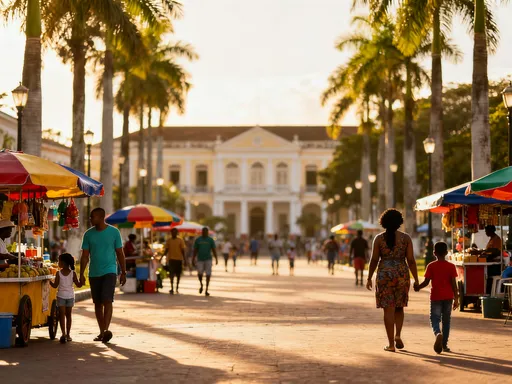
Beyond the geoglyphs, the town of Nazca offers a glimpse into everyday life in the Peruvian desert. Dusty streets lined with adobe houses stretch under a relentless sun. Market stalls overflow with ripe fruit, fresh cheese, and handmade crafts. Children walk home from school in crisp uniforms, waving at passersby. The pace is slow, the air thick with the scent of grilled corn and eucalyptus. This is not a tourist stage set but a real community with routines, rhythms, and resilience.
One of the simplest pleasures is sipping emoliente, a warm herbal drink made from corn silk, plantain, and spices. Served in paper cups at corner stands, it is both refreshing and comforting. Vendors stir large pots throughout the day, offering a moment of pause in the heat. Sitting on a plastic chair by the sidewalk, listening to the hum of conversation and distant music, one begins to feel part of the fabric of the town. These small interactions—smiles, shared laughter, a gesture of kindness—create memories just as lasting as the flight itself.
In the central plaza, elderly men play dominoes under the shade of palm trees. Teenagers gather near the cathedral, texting on their phones. At dusk, families stroll along the promenade, enjoying the cooler air. On weekends, local bands perform in the square, playing Andean melodies that echo through the night. The music carries a quiet pride, a sense of identity rooted in history yet evolving with time. These moments reveal that culture is not confined to museums or ancient ruins—it lives in the way people greet each other, prepare food, and celebrate life.
Nasca, as it is locally spelled, is also a wine-producing region, one of the oldest in South America. Vineyards thrive thanks to the same ancient aqueducts that once sustained the Nazca people. Visitors can tour wineries and taste pisco, a grape-based spirit, or local reds grown in the arid soil. These agricultural traditions, like the pottery and textiles, show how ancient knowledge continues to nourish modern life. The connection between past and present is not symbolic—it is tangible, tasted in every sip, felt in every handshake.
Why This Journey Stays With You – The Deeper Meaning of Cultural Travel
The flight over the Nazca Lines is unforgettable, but what lingers longest is not the view from above—it is the sense of connection. This journey does more than satisfy curiosity; it shifts perspective. It reminds us that human beings have always sought meaning, leaving marks that outlast empires. The Nazca did not build for fame or tourism. They created for belief, for ceremony, for survival. Their lines are not just art or astronomy—they are prayers written in stone and earth.
In an age of mass tourism, where destinations are reduced to hashtags and checklists, Nazca offers a different path. It invites slowness, reflection, and respect. It asks travelers to move beyond spectacle and engage with context—to learn about the people, support the communities, and honor the sacredness of place. This kind of travel transforms the visitor. It fosters humility, curiosity, and a deeper appreciation for the diversity of human expression.
The Nazca Lines challenge us to see differently—not just with our eyes but with our hearts. They remind us that mystery need not be solved to be meaningful. Some questions are meant to be carried, not answered. To witness them is to become a witness to history, to stand in awe of what humans can create when guided by faith, knowledge, and patience.
So when you plan your journey, go not as a spectator but as a participant in preservation. Choose ethical tours, listen to local voices, and carry your respect like a quiet promise. Let the desert winds whisper their stories to you. Let the spider, the hummingbird, the spiral speak across time. Because in the end, the greatest gift of travel is not what you see—but who you become when you truly see it.